
Trading Post
The building that connects your city to the Market.
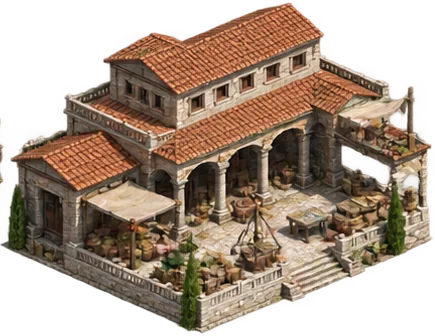
What it gives
| What | Meaning |
|---|---|
| Market access | A city without a Trading Post cannot buy or sell on the Market. |
| Range | How far away the sellers you can buy from may be. |
| Offer slots | How many sale offers your city may have standing at once. Buy orders do not count towards it. |
What a level buys
Range and offer slots both grow with the level. The Trading Post's window shows what they are now and what the next level brings.
The Trading Post's window
Clicking the Trading Post opens a window headed by Your trading rights: your trade reach, and how many sell offers you may keep standing at once. Each line shows the figure now and, after the arrow, the next level's; the next figure is green when that level raises it. Under the reach, for scale, is how far a city on your own island sits; under the offers, how many slots are free. How does reach work? in the head explains whose reach counts when you buy and when you sell; Go to the Market takes you to this city's Market. No order is placed in this window: offers are made at the Market.
The building block at the foot shows the upgrade. While it is under way you still trade at the Market with the old level's rights; the new reach and the new offer slots arrive when the work is done. When you open Lower or demolish, the window says how many slots a level lower would keep, if it keeps fewer. Your standing offers are not removed and stay at the Market, but you cannot make a new one until they number fewer than the new limit. While you have open orders at the Market the Trading Post cannot be demolished altogether; withdraw them first.
What range means
On the Market you see every offer in the world; range decides not what you can see but whom you can trade with. A trade happens only if the seller's city is within the buyer's range. Range is measured from the buyer's city; neighbours on your own island always are within it, and distant islands want a high level.
Range always belongs to the buyer. When you buy, your own Trading Post's range counts; when you sell, the buyer's does: a distant buyer whose range covers your city can take your goods, and your own range has nothing to do with it. Your waiting buy orders grow with your Trading Post: when a new level is finished their range widens too, and lowering or demolishing the post never narrows it. If what you are selling finds no buyer, the reason may be the buyers' range rather than your price.
Carrying is a separate job
The Trading Post makes the trade possible; it does not carry the goods.
To place an order on the Market your city also needs a Port, whether you are buying or selling. What you buy is fetched from the seller's quay by your own transport ships; the seller commits no ships. If your idle ships fall short, your order matches only as much as they can carry and the rest waits in the book (Trade and Transport).
Who needs one
A city with a surplus: what you sell becomes Gold. A city short of one resource: an island with no Marble buys Marble.
And a city that buys grapes — the grapes feeding your Tavern usually come from the Market.
The figures come from the game's own content. Balance updates can move some numbers; the rules themselves are as written here.