
Support Units
The priest, the physician and the engineer do not fight; they look after the army's morale, its wounded and its broken engines.
Three units, three jobs
All three are in the support reserve: they take no frontage, stand in no lane, strike nothing and are struck by nothing. They work between rounds. That is why the tables show their attack as zero and their defence as next to nothing.
All three run out of supplies — in a long war a support unit can be alive and useless.
Each of them looks after a force of a certain size: the priest the whole army, the physician the soldiers, the engineer the siege engines. The bigger the force, the more of them it needs. Bring too few and the work shrinks in proportion; bring too many and each extra one adds less than the one before. The tables below show how many you need.
Priest
 Mantis
He reduces what a bad round takes from morale. He never ADDS morale — if he did, enough of them would make an army immortal.
A reduction needs something to reduce: in a good round the priest does nothing and spends nothing. He can absorb only a bounded share of a round's morale loss, so however many you bring, a catastrophic round is still a catastrophe.
He is not a button that cancels a rout; he only delays the break.
Delay has a price. In an even fight the side with a priest can hold while the other breaks; but in a battle you are losing he keeps your army fighting longer — the enemy loses more men, and so do you.
Physician
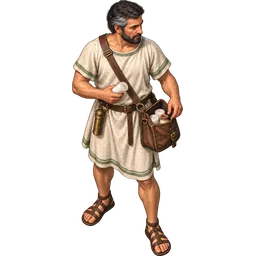 Iatros
Not every soldier who falls in battle is dead; some are wounded. Each round the physician carries a share of that round's fallen off the field as wounded.
A wounded man he saves does not fight again in that battle: he fills no gap in the line and changes nobody's morale; the physician's work does not alter how the fight goes. You see the difference at the end: when your army leaves the field alive — in victory, in rout or under a white flag — the wounded go home with it. A defending garrison's wounded are already home. Since they did not die, they are not struck from your city either.
The share he saves is bounded by three things: how well the physicians cover your soldiers, a ceiling that no number of physicians can pass, and the medical supplies left. Each wounded man costs one unit of supplies; a round in which nobody falls costs nothing.
The battle report and the battle screen put it as “Physicians saved so many wounded”. The casualty figure counts everybody who fell; this line shows how many of those casualties are coming home.
Engineer
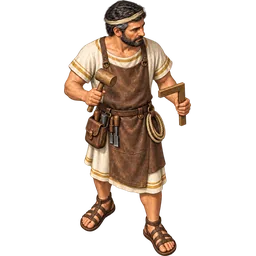 Mechanikos
Siege engines break too. Each round the engineer hauls a share of the engines smashed that round back to be mended.
An engine hauled back does not fire again in that battle: it adds nothing to your attack and never touches the wall. Your army takes it along when it leaves the field, and the engine is used again.
The engineer looks after the siege train, not the army: the engines' citizens decide how many engineers you need, and in an army without engines he has nothing to do. The share he saves is again bounded by his coverage, a ceiling and the repair supplies left.
Fire usually reaches the engines only once the line in front of them has gone, and what strikes them hardest is the defender's own siege engines. The engineer earns his keep in sieges where the other side shoots back.
How many physicians and priests?
| Soldiers | Iatros | Mantis |
|---|---|---|
| 500 | 10 | 9 |
| 1,000 | 20 | 18 |
| 5,000 | 100 | 87 |
| Wounded saved at full coverage: 25% of the fallen, at most 30% | ||
| Wounded one Iatros has supplies for: 10 | ||
The table shows the fewest needed to cover, in full, an army made of soldiers who each cost one citizen. The physician looks after the soldiers alone; the priest looks after the whole camp, the physicians and himself included. Cavalry costs more citizens, so it adds to the load of both; siege engines add only to the priest's.
How many engineers?
| Battering Ram | Citizens | Mechanikos |
|---|---|---|
| 10 | 40 | 5 |
| 30 | 120 | 15 |
| Engines recovered at full coverage: 25% of those destroyed, at most 30% | ||
| Engines one Mechanikos has materials for: 1 | ||
The number of engineers is worked out from the siege train's citizens. The table shows two trains built from the cheapest siege engine; heavy engines cost more citizens, so they need more engineers.
Which one pays off when?
| Unit | When it is worth it | When it is wasted |
|---|---|---|
| Priest | In long, even battles: your morale holds out longer and the enemy may break before you do. | In a hopeless battle: he only makes your army fight longer, at a higher price. |
| Physician | In battles where you expect heavy losses but your army will not be wiped out: even if you are routed, your wounded come home. | In attacks where your army may be destroyed to the last man, because when the camp is overrun the wounded are lost too; and in easy raids where nobody will fall he has nothing to do. |
| Engineer | When you bring a great many siege engines, above all if the defender has engines too. | In an army without engines, or in a battle where nobody can reach your engines. |
When is the support column lost?
Nobody can reach your support units: neither cavalry nor siege engines can strike them. When the last of your soldiers falls, the camp is overrun, and the support column goes with it — together with its stores and the wounded the physicians saved.
An army that leaves the field alive takes its support units with it, along with its remaining stores, its saved wounded and the engines hauled back.
The figures come from the game's own content. Balance updates can move some numbers; the rules themselves are as written here.