
Temple and Monument
Two buildings that give a city its identity, each on reserved ground.
The Temple
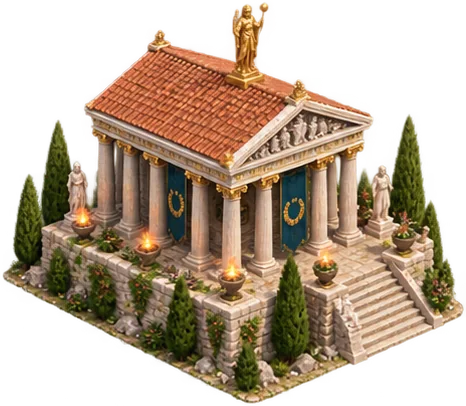 Temple
The Temple is where your city serves a patron god. It goes in this order: you raise the Temple, you choose a god, then you assign idle citizens as priests. You cannot assign priests before choosing a god, because a priest serves a god; in a Temple with no god there is nothing for one to do.
It is the priests who bring the god's effect to the city. A priest produces nothing and pays no tax: make a citizen a priest and the city gives up that citizen's tax. A citizen you made a priest is neither a worker nor a scholar.
What do priests bring?
Every god has a full effect that depends on the Temple's level, and it is reached only when the priest capacity is full. Each priest carries an equal share of that full effect: a half-staffed Temple gives half, an empty one gives nothing.
A Temple does not hold priests without limit. Its priest capacity depends on its level and grows with every level; once the priesthood is full, no more priests can be assigned. The Temple has no last level; its capacity keeps growing by the same amount with every level. Raising the Temple brings two things: a larger capacity and a higher full effect.
So the number of priests says little on its own; read it together with the size of the Temple. In a small Temple a few priests are the whole priesthood and bring the god's full strength at that level; in a large one the same number is a small share. The Temple window shows the effect per priest, the effect a full priesthood reaches and what the number on the slider would bring.
Theocracy strengthens the god's effect, but it does not bless an empty Temple: with no priests there is nothing to strengthen. The figures in the window include it.
Six gods
| God | Grants | Requires |
|---|---|---|
| Ares | Land attack | Barracks |
| Athena | Land defence | Barracks or City Wall |
| Hephaistos | The effect of Arsenal equipment | Arsenal |
| Poseidon | Naval attack | War Harbour |
| Demeter | Population growth | — |
| Hermes | Caravan and shipping speed | Port |
When do the gods work?
To choose a god, the building he asks for must be completed in the city. Demeter asks for nothing.
Ares and Poseidon work in attack: Ares strengthens the army's attack, Poseidon the fleet's. An army or fleet sent to attack carries the blessing its city had at the moment of the order; if you change god or call the priests back afterwards, the blessing of the army on the road does not change.
Athena works for those defending the city, and with the god's strength as it is at that moment: a defender does not choose when the battle comes. Hephaistos strengthens the effect of Arsenal equipment in attack and defence alike; his full effect is higher than the other gods', but he has nothing to add to an army with no equipment.
Demeter raises the speed at which the population grows, Hermes the speed of cargo leaving this city. Neither does anything in battle.
Changing patron
You may change, but the city spends a full day in religious unrest and its happiness falls. The priests stay at their posts and the god changes at once; the price is happiness alone. While the unrest lasts you cannot change the god again.
The unrest does not scale with the world's speed: a day is a day in a fast world too.
The Temple window
The window that opens when you click the Temple starts with the city's patron god: its portrait, its name, what it does and the effect it gives the city now. If the staff is not full, the effect a full staff would reach is written beside it. What do priests do? in the header explains briefly how priests work.
The Priests section shows the share one priest carries and how many free citizens there are. You pick the number of priests with the − and + buttons or the slider; once the number changes, the window says how many citizens become priests, or how many priests return to the free citizens, and what the effect will be. Assign priests or Release priests applies the choice, Undo drops it. With no free citizens left, the slider goes no further.
Change, beside the patron god, opens the god screen. The gods stand side by side; clicking one only looks at it. On the right you read what the god you are looking at does, what it gives with a full staff, the share per priest and what the current god takes away with it. The line at the bottom states the price of the change; the first choice is free. A god whose building your city lacks shows as locked, and the line names the building it waits for. ← Temple or Cancel goes back without changing anything.
The upgrade sits at the bottom of the window and writes the next level's priest capacity and effect in green. Under Lower or demolish, each choice says how many priests no longer fit the new capacity and return to the free citizens; to demolish the Temple altogether you type DEMOLISH in the box.
The island's altar
An altar stands on the plaza in the middle of every island, and one of the six gods is that island's own. The island's god is chosen when the island is made and never changes. Click the plaza on the island map to open the altar's window. Only players with a city on the island see the altar's level, the gods of the island's cities and the donations. Somebody looking at another island's altar sees only that island's god. On the world map, too, every island shows the altar of its own god on its plaza.
The more of the island's cities serve this god, the greater the god's effect in every city that does. A city serves when its Temple is dedicated to the island's god and at least one priest works there. The boost comes in tiers: each time the share of cities serving passes a threshold, the island rises a tier. The gods of war gain less than the others. The boost adds to Theocracy's, and it does not bless an empty Temple.
Not every city is counted. Cities of players on vacation, under beginner protection, who have left the game or have not played for a long time are left out, and a newly founded city waits a few days. That way founding a colony on the island is no easy way to spoil the count. Each of a player's cities on the island counts on its own.
The altar does not come ready; the islanders build and raise it with gifts. The altar's level sets the highest tier the island can reach: even if everyone serves the same god, a low altar holds the boost where it is. Gifts are made in marble, iron or grapes; you can give several at once in one gift, and each counts the same. A gift comes out of the store of one of your cities on the island. A built altar never loses a level.
When a city's god or priests change, the island is counted again at once; changes that happen by themselves, such as a vacation, protection or a long absence, reach the count within a few minutes. When the altar reaches a level or the island's tier changes, everyone with a city on the island finds it in their Events. If a city's god is the island's god, the Temple window also shows what the altar adds. An army that marches out carries the god's strength as it is at that moment.
The altar in numbers
| Altar level | Gift (Marble · Iron · Grapes) |
|---|---|
| 1 | 30,000 |
| 2 | 100,000 |
| 3 | 300,000 |
| Tier | Share of cities serving | Ares · Athena · Hephaistos · Poseidon | Demeter · Hermes |
|---|---|---|---|
| 1 | 50% | +10% | +15% |
| 2 | 75% | +20% | +30% |
| 3 | 100% | +30% | +50% |
The first table shows what each altar level asks in gifts; the second, the share each tier asks for and what it adds to the gods' effect.
The Monument
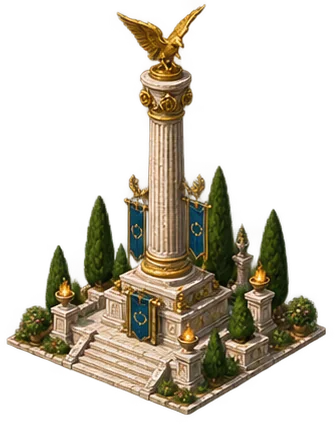 Monument
The Monument is the game's only single-level building: level one, and there it stays. It stands on its own plinth, it is expensive, and its only mechanical effect is happiness.
There are ten standard appearances — from the Victory Column to the Heroon — and all ten are mechanically identical: the choice is entirely about your city's story. Commissioning a custom monument MULTIPLIES the contribution rather than adding a second one. The appearance can be changed later.
One seasonal appearance comes on top of them: the Harvest Pumpkin, a carved pumpkin with a lamp burning inside, on a marble plinth. It can be chosen only in the Halloween season; the days it is on offer are written on its card in the Monument window. Choosing it is free, and it gives the same happiness as any other standard monument. When the season ends it leaves the list and can no longer be chosen, but a city that wears it keeps it and keeps the happiness.
The Monument window
Clicking the Monument opens a window that starts with what stands in the city: its picture, its name, what it depicts and the happiness it adds. If the game put it up, the window says so as well.
The Change its face section below has two tabs: Standard holds the standard monuments, Custom your finished designs. The one standing in the city is marked "In the city". A design standing in another of your cities is marked with that city's name, and it cannot be put up here. Pressing a card selects it; pressing it again lets it go.
The line at the bottom of the window describes your choice: which monument it replaces, what it costs and how much the happiness changes. Change its face makes the change at once; the building and its level stay the same. Cancel drops the choice. If your treasury does not hold the price in Gold, the button stays off and the line says why.
New design above the monument cards, and Make a custom monument, the first card of the list, both open the Custom monuments window. The Monument is not upgraded; Demolish at the bottom of the window takes it down, but first asks you to type DEMOLISH in the box. A custom design on a demolished Monument is not deleted; you can put it up again when you rebuild the Monument, or in another of your cities.
Commissioning a monument
You can also have your monument designed for you: you write what it should commemorate and, if you like, add a picture; the game renders it in its own visual language — the same view, the same light, the same stone. A design is paid for in Seals, and only once it has been drawn successfully.
A design belongs to your player in the world you made it in, and can only stand in your cities in that world. What to write, adding a picture, payment and the content rules are explained with examples in the Custom monument article.
The figures come from the game's own content. Balance updates can move some numbers; the rules themselves are as written here.