
Fleets
Sending warships to sea: the fleet order, the two lines, and what it costs.
What is a fleet?
Warships are built at the War Harbour, and they no longer have to sit there: you can form a fleet and send it to sea.
A fleet sent to another harbour is ordered on the map: in the city's window, Attack the harbour strikes, and Send a fleet anchors in an ally's harbour, frees a harbour or reinforces one you hold. The Fleet tab of the order window on the army screen is for moving between your own harbours and reinforcing the harbours you hold. The fleet order lives in the same ledger an army does but it is a different order: a fleet is made of warships, and an army holds none.
Army and fleet
| Question | Army | Fleet |
|---|---|---|
| What it is made of | Soldiers | Warships |
| How it crosses the sea | Aboard transport galleys | On its own hulls |
| What it carries | Soldiers, plunder, load carts | Nothing |
| When it leaves | Boards at the War Harbour first, if it crosses | The moment you give the order |
| Speed | Its slowest soldier or hull | Its slowest hull |
Where a fleet goes
A fleet can be sent four ways: to lie in one of your own harbours, to strike a hostile harbour and come home, to take a harbour and hold it, and to free a blockaded one. You can also reinforce a harbour you hold, and join the defence of any harbour being fought over with Defend the harbour (Joining a battle in progress). Warships sent to lie in one of your own harbours become that city’s ships the moment they arrive and take their orders from it.
A warship is heavy: it crosses the same water more slowly than the Transport Galleys that carry your army. Even between two of your cities on one island a fleet goes by sea, rowing round the coast. A fleet's voyage also has a shortest time: neither the fastest hull nor the research that speeds ships at sea makes it shorter.
A city held under land occupation can still put its warships to sea: a land occupation does not keep the navy in port.
A harbour of yours that somebody else holds is another matter: you cannot give the warships in it a fleet order, and they leave only by fighting their way out.
Striking, holding, freeing and reinforcing are separate purposes. Under What is it for, the window shows the ones that can go to the harbour you clicked as cards, and each card says what that purpose does.
The two lines
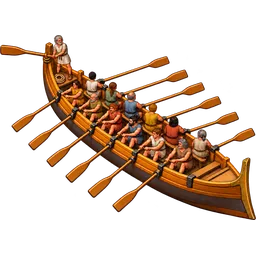 Lembos
| Line | What it does |
|---|---|
| Screen | Light, cheap hulls. They fight the enemy's light ships and stand in front of the heavy ones. |
| Line | Heavy hulls. These are what decides a battle at sea. |
The warships
| Ship | Lane | Attack | Defence | Endurance | Citizens | Gold/hour | Cost | Building | Research |
|---|---|---|---|---|---|---|---|---|---|
| Lembos | Screen | 24 | 40 | 150 | 2 | 3 | 260 Wood | War Harbour lv. 1 | — |
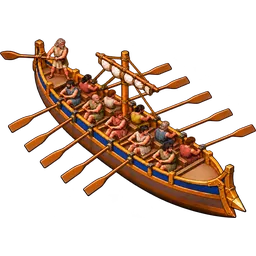 Hemiolia | Screen | 42 | 50 | 230 | 3 | 5 | 60 Iron, 380 Wood | War Harbour lv. 4 | Maritime Logistics |
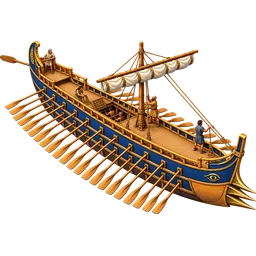 Trireme | Line | 106 | 40 | 380 | 6 | 9 | 140 Iron, 620 Wood | War Harbour lv. 8 | Naval Architecture |
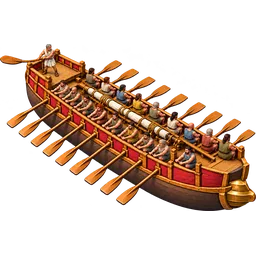 Quadrireme | Line | 170 | 50 | 570 | 8 | 13 | 240 Iron, 120 Stone, 900 Wood | War Harbour lv. 13 | Naval Organisation |
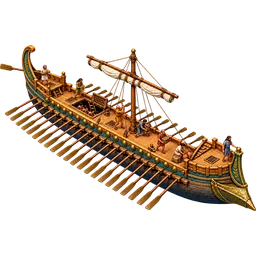 Quinquereme | Line | 235 | 57 | 760 | 10 | 18 | 380 Iron, 180 Stone, 1250 Wood | War Harbour lv. 19 | Marine Tactics |
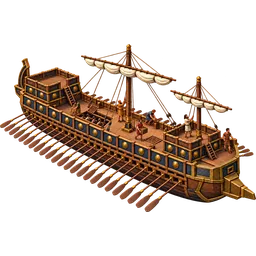 Deceres | Line | 352 | 64 | 1100 | 16 | 30 | 620 Iron, 300 Stone, 1900 Wood | War Harbour lv. 26 | Thalassocracy |
The figures come from the game's own content and can move in a balance pass.
A battle at sea
When your fleet strikes another player’s harbour, a battle opens in the water in front of it. Rounds are as long as on land, and the battle runs until one side has nothing left on the water or gives up.
The defence is whatever lies in that harbour: the city’s own warships and any fleet its owner has stationed there. Soldiers and transport galleys take no part in it.
Every warship finished in that harbour while the battle runs joins the line at the next round. That is what lets a blockaded owner build their way out of one.
How it differs from land
| What | At sea |
|---|---|
| Wall | None. There is no masonry in front of a harbour. |
| Lines | Screen and line; no front rank, ranged lane, flank or siege line. |
| Ammunition | None. |
| The city’s supply | None; the workshops do not reach the water. |
| Morale and routing | Work exactly as they do on land. |
| Giving up | The white flag works exactly as it does on land. |
| Plunder | None. |
What it costs
A fleet under way is paid for like a campaign ashore: twice the ordinary upkeep. Lying in one of your harbours it costs the ordinary rate.
Before you give the order, the fleet window states the length of the voyage and both prices.
Recall and coming home
Recalled under way, a fleet turns round where it is: the way home takes as long as the voyage has taken so far.
Lying in one of your harbours, an order to come home is a fresh voyage, measured when you give it.
The figures come from the game's own content. Balance updates can move some numbers; the rules themselves are as written here.