
Academy
Where Knowledge is produced — by scholars, not by the building.
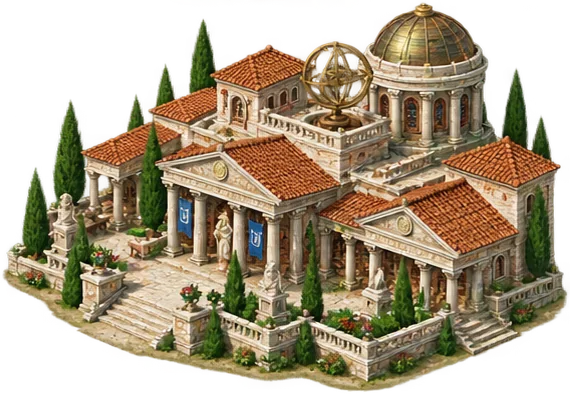
How it works
The Academy produces nothing by itself: it opens scholar places, and scholars produce the Knowledge.
You raise the Academy, assign the city's idle citizens as scholars, and each scholar produces some Knowledge an hour and draws a wage.
Academy or population?
The Academy's level opens scholar places; the Town Hall's level gives you the people to fill them. Which one is short is told by the places themselves.
If your scholar places sit empty, what is short is not the Academy — it is the Town Hall and happiness. If the places are full and you want more Knowledge, what is short is the Academy.
The Academy window
The strip at the top of the window shows your free citizens, this city's Knowledge per hour and the city's net Gold. The Research link at its right opens the research screen.
In Scholars you choose how many citizens work here by sliding, by typing the number or with Most. The slider reaches as far as the Academy's places and your free citizens allow; the line under it says how many citizens stay free, or why you cannot assign more. As you choose, the strip, this city's Knowledge and the wages follow the new number at once. A citizen who becomes a scholar starts drawing a wage and stops paying tax; net Gold counts both.
Your choice is not saved until you press the button at the bottom; Reset goes back to the saved number. If the connection drops, your choice stays in the window and Try again sends it once more. If the game does not accept it, the reason is written beside the button and the window goes back to the saved number.
The Knowledge section shows the Knowledge you have stored, and what this city and all your cities add every hour. Knowledge is not spent here; you open research on the research screen. Once you have researched everything, the line under this section sends you to the Arsenal: if one of your cities has an Arsenal it opens it; if none has, it says what is missing to build one in this city.
At the bottom stands the building itself: the next level, its price and Upgrade. What does it bring? shows how many scholar places it opens and how much Knowledge this city would make with the Academy full. While the Academy rises, the scholars keep working. Open Lower or demolish and it says beforehand how many scholars no longer fit in the smaller Academy; they join the free citizens.
Scholars are expensive
A scholar draws several times a worker's wage; that is a deliberate trade. Your Gold income is tax and your outgoings are wages — turn your whole city into scholars and the Gold drains away.
Research belongs to the PLAYER, not the city: whichever city's Academy produced it, Knowledge pools once and your research opens for the whole empire.
What to do with a citizen
| Assign as | Returns | Costs |
|---|---|---|
| Worker | Resources | A low wage |
| Scholar | Knowledge | A high wage |
| Idle | Tax only | Nothing |
How much Academy?
The Academy costs more at every level; it has no last level, and the price of the first level is in the building table.
A player who wants the whole research tree cannot neglect the Academy — but a tall Academy on its own is worth nothing. It needs a city to fill it and an income to pay the wages.
What does a research need?
Every research needs Knowledge, and some need other research first. Research deep in the tree also needs your buildings: the Academy at a certain level and, for military, seafaring, engineering and economy research, the Barracks, the Port, the Siege Workshop or the Warehouse too. What counts is the highest level among all your cities. The research screen says, for every research, which building it needs at which level and what yours is.
Once you have finished part of the tree, research gets dearer: from that point every research you finish raises the price of the next one a little more. The price shown on the research screen is the price you pay at that moment. Every box in the tree says its own state: a research you have learned has a green ground and ✓ Learned in place of its price. One you can start now has a thick frame and Open before its price. A locked one is faint with a dashed edge and a padlock before its price. The strip above the tree shows these states the same way.
How long does research take?
The moment you start a research its price leaves your Knowledge; the research then runs for a while, and its effects begin when it is done. The time follows the price: cheap research is quick, dear research takes long, but none goes past a set limit. The higher your Academy, the shorter the time. The research screen shows beside each research how long it would take if you started it now.
One research runs at a time; another cannot start until it is done. The running research is shown at the top of the research screen with its time left; press that line and the research is picked and brought into view in the tree. Its box in the tree shows how much of it is done, as a percentage, in place of the price. When it is done the bell tells you, and if you have turned notifications on, your phone or browser gets one too. If you stop the running research, all the Knowledge you paid comes back. While you are on vacation the research's time stands still too.
Knowledge after the tree
Finishing the research tree does not make Knowledge worthless. After the last research your scholars keep working and Knowledge keeps building up; from then on you spend it in two places: on the Mastery research at the foot of the research screen, and at the Arsenal, on your units' equipment.
Mastery is six researches that open once every research of the tree is done: production of goods in all your cities, building speed, the attack and the defence of your land units, the speed of your ships and the speed of shipbuilding. Each is taken level by level and stops at a set level. Every level adds its effect once more, costs more than the one before and runs for a while like any other research; still only one research runs at a time. Its card says what it gives now and what the next level would give.
Every Arsenal improvement costs Knowledge as well, and equipment has no last level. An equipment level cannot pass the Arsenal's own level, but once the Arsenal reaches level twenty that limit is lifted and you can improve equipment as far as you like. Each level costs more than the one before while its gain keeps shrinking, so the Knowledge you build up always has somewhere to go. In detail: Arsenal.
The figures come from the game's own content. Balance updates can move some numbers; the rules themselves are as written here.