
Raiding
What a victorious army takes, what it cannot, and why it may come home with less than it asked for.
What a raid is
An attack that wins may carry plunder home from the city it took. This is not a mechanic beside the battle; it is what the battle was for.
Plunder comes in three kinds: goods from the city's store, Gold from its treasury, and captives from its civilians.
A raid is not free. From the moment your army sets out until it is home it pays campaign upkeep, including after it has loaded the plunder and turned for home (Army Upkeep). Count that in when you weigh the profit.
Battle and plunder
| Measure | Battle | Plunder |
|---|---|---|
| What happens | Two armies fight | The winner takes what it can carry |
| When | From arrival, round by round | When the battle ends, and only if it was won |
| Result | Victory, defeat or rout | Plunder, or nothing at all |
Step by step
| Step | What you do |
|---|---|
| 1 | Pick the target city on the island |
| 2 | In the city window, press Attack the city |
| 3 | Choose the troops |
| 4 | Leave the purpose on Raid and set the plunder priorities |
| 5 | Check the journey and what your army can carry |
| 6 | The army travels and fights |
| 7 | If it wins, the plunder is worked out and loaded |
| 8 | The army carries it home |
| 9 | The plunder is yours to spend only once it arrives |
Plunder priorities
| Category | What it covers |
|---|---|
| Goods | Wood, Stone, Marble, Iron, Grapes |
| Gold | From the treasury and from buy orders waiting on the market |
| Captives | From the city's civilians |
Goods is one category
You do not pick Wood, Stone, Marble, Iron and Grapes separately. The goods share is divided as evenly as it can be among whatever the target city can actually lose.
If the city has lootable wood, stone and grapes but no marble or iron, the goods share is split between those three. If the wood runs out before its part is filled, what is left of it passes to the others: no carrying capacity is wasted while there is still plunder to take.
A category you did not choose is never loaded. Give Gold nothing and no coin goes in your carts.
Why you may get less
The city does not hold that much; what you wanted is under the Warehouse’s protection; there are separate ceilings on how much Gold and how many people a raid may take; your army cannot carry it; or you lost the battle.
What is safe
Goods the Warehouse protects cannot be plundered. The goods share is divided only among what falls outside that protection.
However much a city holds, the protected part is out of reach, and it is the first limit a raid meets. A city whose whole store fits inside the Warehouse’s protection loses no goods at all. That protection is enlarged by the city's Warehouses and by the lock fitted to its store: the same army brings back less from a locked city.
Goods you have listed on the market stay in your store, and a raid reaches them too. The Warehouse’s protection is spread across everything you own, listed goods included. The raider takes from the goods no offer holds first; if that is not enough, the rest comes off your sell offers for that good. Your newest offer goes first, and it shrinks by as many units as were carried off. An offer left with no units closes. In short, listing goods at a price nobody will pay does not protect them from an attack (The market).
Gold
Gold is a plunder category too, but unlike the others it does not sit in a store: it is in the player's treasury.
Gold waiting in your buy orders on the market is not safe from a raid either. When you place a buy order, that Gold leaves your treasury and waits in the order, but it comes back if you cancel, so it is still yours. A raid works out its share over both together and takes from the treasury first. Whatever the treasury cannot cover comes out of your buy orders: the most recent order goes first, an order shrinks by as many units as the Gold taken needs, and what is left over from the last unit returns to your treasury. An order with no units left closes. In short, moving Gold into a buy order when an attack is coming does not protect it (The market).
Gold thirty per cent does not mean thirty per cent of the treasury; it means aim thirty per cent of your carrying capacity at coin. Only the separately lootable part of a treasury can be taken, and you cannot see a target's Gold before you attack.
Plundered Gold comes home with the army and can be spent only once the army arrives.
Captives
A won raid may carry off a city's eligible civilians. Captives twenty per cent does not mean carrying off a fifth of the city's people: it means aim a fifth of your carrying capacity at them.
Soldiers are never taken this way and the dead are never turned into captives. Captives use up carrying capacity, and a great deal of it.
When your army gets home they become ordinary citizens of your city: they pay tax and can be sent to work a deposit. With no housing for them, they do not arrive.
Load carts: soldiers fight, carts carry
On a raid on a city on your own island the soldiers march overland: what you bring home is decided by the load carts and transport galleys you take with you. The galleys follow the coast, and since no soldier is aboard, their whole hold is left for plunder. You may take carts, galleys or both. How many soldiers you take decides whether the city falls; how many carts and galleys you take decides how much comes home. The two are independent — you may march on a lightly held city with ten soldiers and come back with sixty carts.
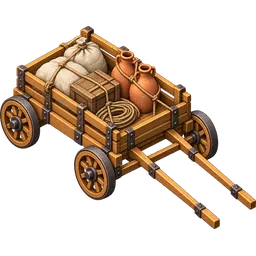
Losses do not shrink the hold: a cart does not fight, does not die and takes no place in a formation. A load cart is a vehicle and is built in the Siege Workshop — beside the ram, for wood, Gold and time. It takes population but costs no upkeep. It is the land twin of a transport galley: the same hold, the same status. It does not slow the column. A cart is committed for the whole journey and comes back into the city when the army does; a defeat, a withdrawal and the loss of every last soldier all bring it home — empty, and by road. Carts also carry goods between your own cities on the same island (Trade); a cart carrying goods cannot go on a raid.
You may raid with no carts at all: the expedition fights and may win, but it brings home nothing — no goods, no Gold, no captives. The order screen says so before you send it. A raid to another island carries its plunder in ships instead, and is offered no carts.
The three figures on the army screen
| Figure | What it means |
|---|---|
| Owned | Every load cart this city has. |
| On the road | The ones out with an expedition or carrying goods; they cannot be sent again. |
| Free | What a new expedition may take. |
What your army can carry
On a raid across the sea, plunder is carried by the soldiers who survive: lose half your army and less comes home. The ships' hold counts too — whatever the surviving soldiers do not fill: the space the dead took is left for plunder. To carry more, send extra transport ships on top of the ones your army needs — they give more room to carry plunder, not a promise of more plunder. On a raid on your own island only the load carts set the capacity, and losses do not shrink it. The order window warns you when there is no room left for the plunder: on a raid across the sea, when the ships have no hold left over once the soldiers are aboard; on a raid by land, when there are no carts at all. Beside the warning, the Add idle ships button (Add idle carts on land) adds your idle ships or carts to the order. The game never adds anything for you and never blocks the order: a raid that carries little can still be sent. An army bound for a pirate cove is warned when it could carry only a small share of what the cove's store holds; driving off a blockade brings no plunder, so it is never warned.
Extra ships are real ships: they are away from your harbour for the whole expedition and free again only once they are home. If the raid is beaten or you raise the white flag, the extras come home with the soldiers, empty; that is the price of sending more than you needed.
Coin is dense: a cart holds a great deal of it. People are not. An expedition that wants people cannot also want everything else.
When there is plunder
| Result | Plunder |
|---|---|
| No defenders left and the way in is open | yes |
| The defence routed and the way in is open | yes |
| The wall still stands | no |
| Your army routed | no |
| Your army was destroyed | no |
The journey home
Plunder does not teleport. The battle ends, the carts are loaded, the survivors set out, they arrive — and only then does the Gold reach your treasury, the goods your store and the captives your city. If the army crossed the sea, loading takes time: the plunder and the survivors are put aboard on the enemy shore, and the army screen shows Loading spoils. The more plunder and the more survivors there are, the longer the loading takes. Your own War Harbour sets the pace — as it stood the day the army set out; the enemy's harbour does not speed it up. On the same island nothing waits to load. The plunder is delivered the instant the army is home; there is no unloading.
Plunder on the road cannot be spent. The report says On the road until it lands, and Home once it does. If your store has no room left, what does not fit is lost, exactly as it is for a returning trade convoy.
The raid report
The report shows how much of each individual resource actually came back, the Gold taken, the captives taken, what carried the plunder — load carts or transport ships — and which step it has reached: battle won, plunder loaded, on the road, home.
The report does not repeat the split you ordered; it says only what actually came. What you asked for and what you got are seldom the same.
The report gives the hold's capacity, how much of it was filled and how much came back empty, separately. Every line of plunder carries two numbers: the amount in its own unit — timber, stone, marble, iron, grapes, Gold or people — and the space it took up in the hold. The two are never added together; 1,500 Gold and 1,500 timber are not the same load. The space that came back empty is room you could have filled and did not: the target had no more to take, or your priorities did not ask for it.
The plundered side sees what left, not how large the raider's hold was; that would give away how much the enemy can carry. Carrying nothing home is not the same as having no record: a city with nothing left to take yields nought, and the report says nought; a raid from before these records says it is unknown.
Finding nothing
A won battle can end with no plunder at all: the city was poor, its goods were under the Warehouse’s protection, or you took neither load carts nor transport galleys on a raid on your own island. That is a result rather than a fault, and the report says so plainly.
The figures come from the game's own content. Balance updates can move some numbers; the rules themselves are as written here.